Protecting the Official or Protecting Public Trust? The Reputational Buffer Dilemma in Government Cricis Communication
Keywords:
Bureaucratic reputation, Crisis communication, Government communication, Public trust, Reputational Buffer DilemmaAbstract
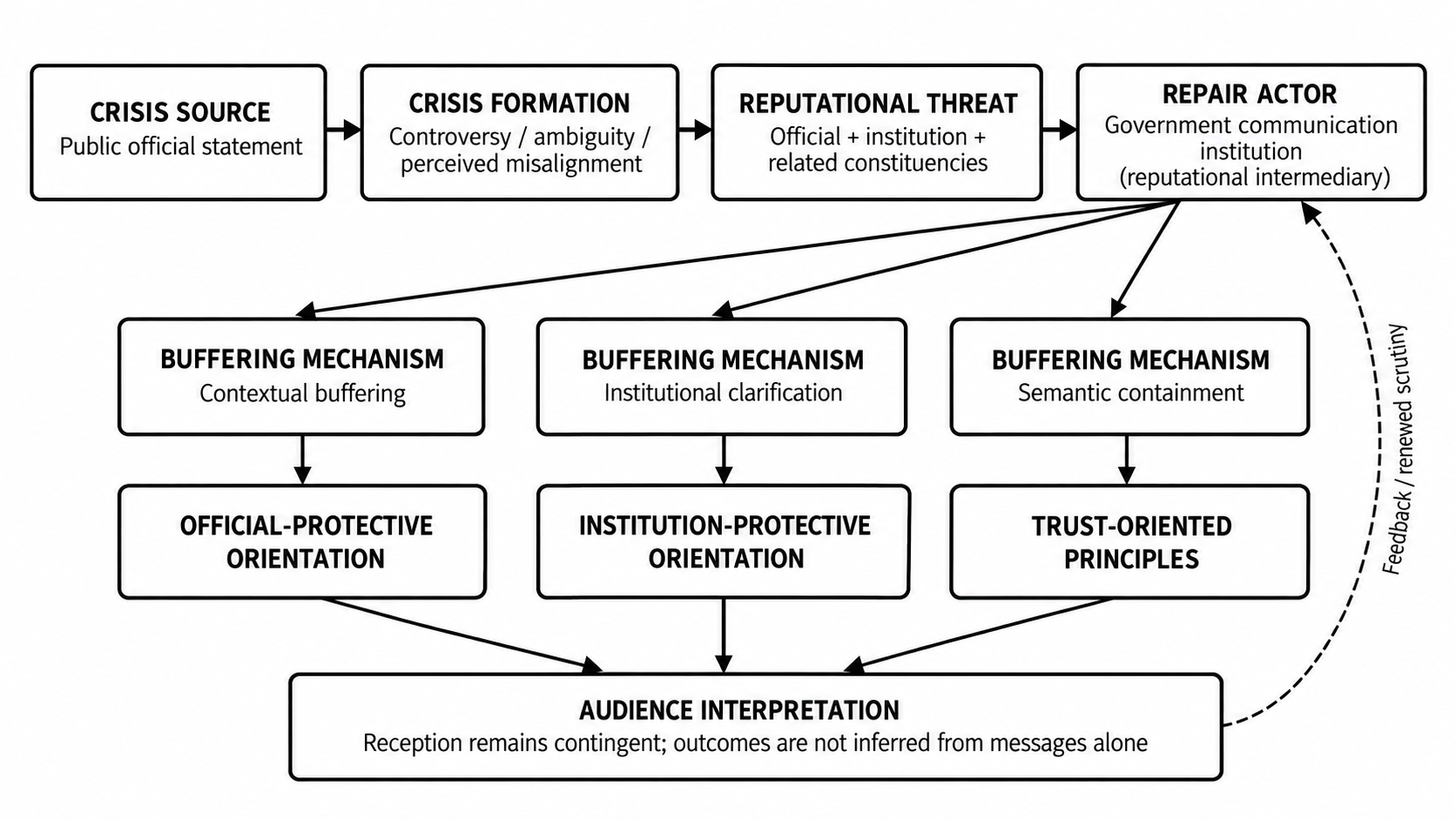
Government crisis communication becomes particularly complex when reputational threats originate from statements made by public officials rather than from institutional failures. This study examines how government communication institutions mediate such controversies and introduces the concept of the Reputational Buffer Dilemma. Using a qualitative comparative case-study design, the research analyzes three communication crises involving Indonesian central government actors between September 2025 and September 2026. Data were drawn from official statements, government documents, press releases, and media reports and analyzed through Situational Crisis Communication
Theory, Image Repair Theory, and Bureaucratic Reputation Theory. The findings identify three mechanisms of institutional intervention: contextual buffering, institutional clarification, and semantic containment. These mechanisms demonstrate that the crisis source and the repair actor may be institutionally distinct, and that communication institutions can perform delegated image repair while simultaneously managing the reputational interests of officials, institutions, and public-facing trust orientations. The study extends crisis communication theory by conceptualizing institutional communication as a mechanism of reputational mediation and spillover management. It further emphasizes that trust-oriented communication should be distinguished from empirically demonstrated changes in public trust. The Reputational Buffer Dilemma is proposed as a mid-range framework for analyzing official-generated communication crises.
References
Al-Omoush, K. S., Garrido, R., & Cañero, J. (2023). The impact of government use of social media and social media contradictions on trust in government and citizens’ attitudes in times of crisis. Journal of Business Research, 159, 113748. https://doi.org/10.1016/j.jbusres.2023.113748
ANTARA. (2026a, July 27). Kemkomdigi ajak publik lihat pernyataan Presiden secara utuh. ANTARA News.
ANTARA. (2026b, May 6). Bakom rangkul New Media Forum perluas jangkauan komunikasi publik. ANTARA News.
Benoit, W. L. (1995). Accounts, excuses, and apologies: A theory of image restoration strategies. State University of New York Press.
Benoit, W. L. (2015). Image repair theory. Oxford Bibliographies in Communication. https://doi.org/10.1093/OBO/9780199756841-0103
Bloomberg Technoz. (2026a, May 7). Forum New Media bantah Qodari soal jadi mitra Bakom.
Bloomberg Technoz. (2026b, May 8). Kronologi hingga dalih Bakom soal New Media jadi mitra pemerintah.
Boon, J., Verhoest, K., & Wynen, J. (2020). What determines the audiences that public service organisations target for reputation management? Policy & Politics, 48(2), 295–314. https://doi.org/10.1332/030557319X15613697611542
Carpenter, D. P., & Krause, G. A. (2012). Reputation and public administration. Public Administration Review, 72(1), 26–32. https://doi.org/10.1111/j.1540-6210.2011.02506.x
Coombs, W. T. (2007). Protecting organization reputations during a crisis: The development and application of Situational Crisis Communication Theory. Corporate Reputation Review, 10, 163–176. https://doi.org/10.1057/palgrave.crr.1550049
Coombs, W. T. (2022). Situational Crisis Communication Theory (SCCT): Refining and clarifying a cognitive-based theory of crisis communication. In W. T. Coombs & S. J. Holladay (Eds.), The handbook of crisis communication (2nd ed.). Wiley. https://doi.org/10.1002/9781119678953.ch14
Gao, X., & Wang, Z. (2024). How does a government crisis communication strategy affect public trust in local government? Evidence based on a survey experiment. China Public Administration Review, 6(3), 76–98. https://doi.org/10.26599/CPAR.2024.9680304
Gierth, L., Geppert, J., & Janzik, R. (2026). Citizens’ reasons for trust in and distrust of governmental crisis communication in six European countries and the US. Journal of Trust Research. https://doi.org/10.1080/21515581.2026.2699080
Hua, P., Wu, Y., & Niu, R. (2026). No organization is an island: How crisis history, temporal distance, and response strategy influence organizational reputation in spillover crises. Journal of Contingencies and Crisis Management, 34(2), e70149. https://doi.org/10.1111/1468-5973.70149
IDN Times. (2026, May 7). Sederet media bantah Qodari soal gabung New Media Forum.
Kamboh, S. A., Ittefaq, M., & Jin, Y. (2024). Crisis communication for public organizations: Examining Pakistan Railways’ use of information technology and social media for image repair. Journal of Contingencies and Crisis Management, 32(1), e12496. https://doi.org/10.1111/1468-5973.12496
Kementerian Hak Asasi Manusia Republik Indonesia. (2026, September 23). Menteri HAM klarifikasi pernyataan Presiden Prabowo soal ‘Pakar Post-Truth’.
Lee, D. (2022). Managing bureaucratic reputation in the face of crises: An experimental examination of the effect of strategic communication. Public Administration Review, 82(6), 1124–1137. https://doi.org/10.1111/puar.13520
Liputan6. (2026, May 8). Klarifikasi Bakom soal daftar homeless media sebagai mitra.
Republik Indonesia. (2025). Peraturan Presiden Republik Indonesia Nomor 96 Tahun 2025 tentang Badan Komunikasi Pemerintah. Lembaran Negara Republik Indonesia Tahun 2025 Nomor 150.
Suara.com. (2026, May 6). Rangkul homeless media, Bakom perkenalkan mitra baru New Media Forum.
Susilo, D., Putranto, T. D., & Navarro, C. J. S. (2022). Indonesian public officials after erroneous statements about COVID-19: An application of image restoration theory. Frontiers in Political Science, 4, 1062237. https://doi.org/10.3389/fpos.2022.1062237
The Jakarta Post. (2026a, July 24). Prabowo calls some journalists, critics ‘londo ireng’.
The Jakarta Post. (2026b, July 27). Press unions demand apology from Prabowo for denigrating comments.
Willems, J., Waldner, C., Winter, V., & Wiedemann, F. (2025). Bureaucratic Reputation Theory: Micro-level theoretical extensions. Perspectives on Public Management and Governance, 8(2), 77–92. https://doi.org/10.1093/ppmgov/gvaf004
Zheng, Q. (2023). Restoring trust through transparency: Examining the effects of transparency strategies on police crisis communication in Mainland China. Public Relations Review, 49(2), 102296. https://doi.org/10.1016/j.pubrev.2023.102296