Digital Appropriation among Women-Owned MSMEs and Household Economies in Jayapura City
Keywords:
New Media, Women-Owned MSMEs, Digital Appropriation, Digital Entrepreneurship, Household EconomyAbstract
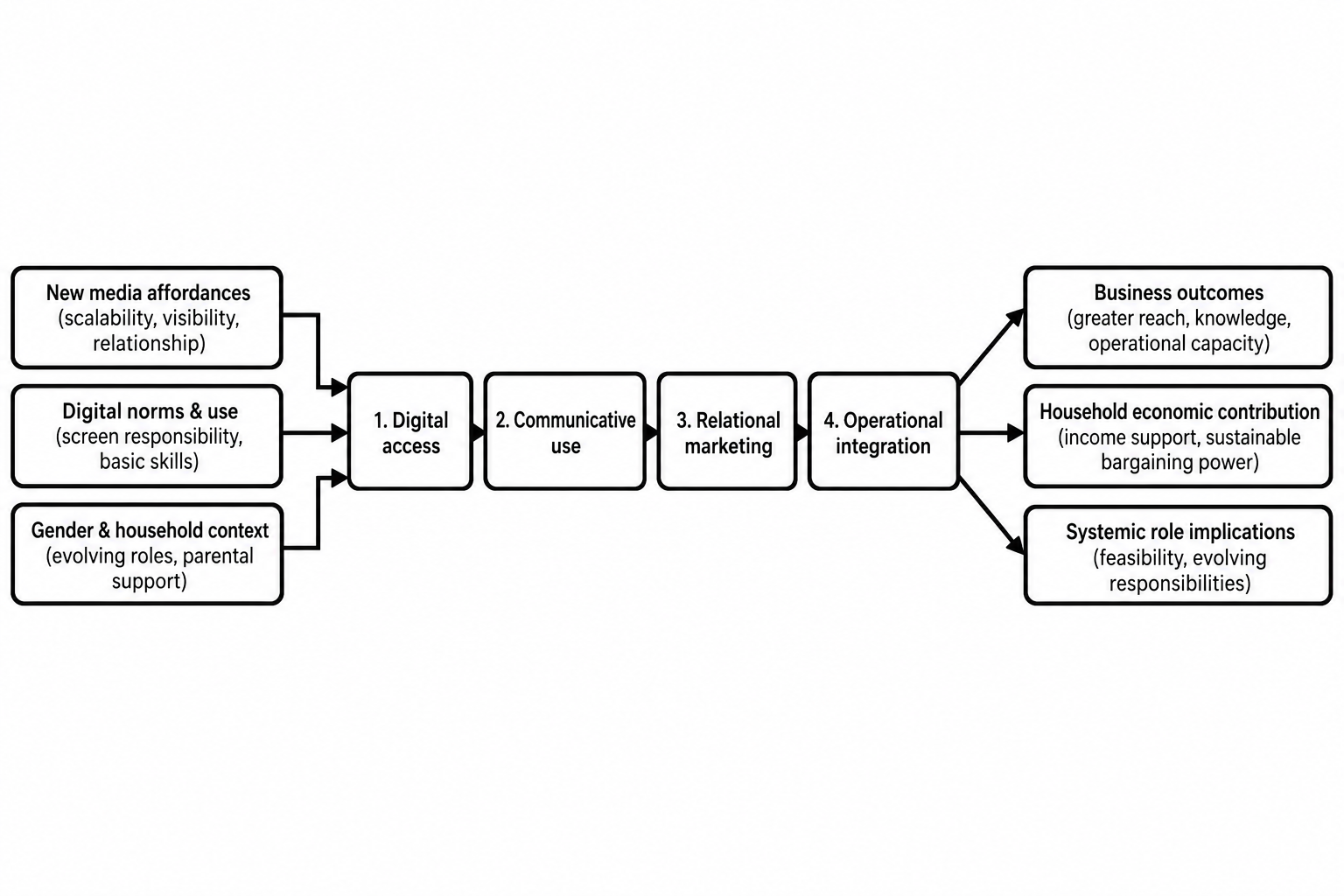
Digital transformation offers women-owned micro, small, and medium enterprises (MSMEs) new opportunities to expand markets and contribute to household economies, yet access to social media does not automatically produce strategic business use. This study examines how women-owned MSMEs in Jayapura City appropriate new media for promotion, learning, customer relationships, business operations, and the negotiation of domestic roles. Using a descriptive qualitative approach, the study analyzes interviews conducted on 28–30 May 2023 with three documented business cases through thematic analysis and a digital appropriation framework. The findings identify a four-stage gradient: digital access, communicative use, relational marketing, and operational integration. Movement across these stages depends on digital skills, social networks, logistics, work organization, and household time arrangements. Social media can serve as a low-cost infrastructure for business learning and customer engagement, while home-based digital work offers spatial flexibility without eliminating domestic burdens. The study concludes that digital empowerment is best understood as the capacity to convert technological access into knowledge, market relationships, operational capability, and a stronger contribution to household economic life.
References
Badan Pusat Statistik Kota Jayapura. (2024, May 8). Indeks Ketimpangan Gender (IKG) Provinsi Papua 2023 [Gender Inequality Index (GII) of Papua Province, 2023]. Badan Pusat Statistik.
Braun, V., & Clarke, V. (2006). Using thematic analysis in psychology. Qualitative Research in Psychology, 3(2), 77–101. https://doi.org/10.1191/1478088706qp063oa
Hopkinson, G. C., & Aman, A. (2017). Women entrepreneurs: How power operates in bottom of the pyramid-marketing discourse. Marketing Theory, 17(3), 305–321. https://doi.org/10.1177/1470593117704280
Irawan, A., Yendra, Y., Sutisna, E., Marihi, L., Mardatillah, M., & Soelistya, D. (2024). Digital inequality and digital entrepreneurship in Indonesia. Jurnal Aplikasi Manajemen, 22(1), 193–204. https://doi.org/10.21776/ub.jam.2024.022.01.15
Laksmanawati, J., & Yuniawan, A. (2021). Women and the digitalization strategies of micro, small, and medium enterprises in the new normal era. Petra International Journal of Business Studies, 4(1), 55–64. https://doi.org/10.9744/ijbs.4.1.55-64
Lister, M., Dovey, J., Giddings, S., Grant, I., & Kelly, K. (2009). New media: A critical introduction (2nd ed.). Routledge.
Loh, Y. A.-C., & Chib, A. (2022). Reconsidering the digital divide: An analytical framework from access to appropriation. Information Technology & People, 35(2), 647–676. https://doi.org/10.1108/ITP-09-2019-0505
McQuail, D. (2000). McQuail’s mass communication theory (4th ed.). Sage.
Melissa, E., Hamidati, A., Saraswati, M. S., & Flor, A. (2015). The internet and Indonesian women entrepreneurs: Examining the impact of social media on women empowerment. In A. Chib, J. May, & R. Barrantes (Eds.), Impact of information society research in the Global South (pp. 203–222). Springer. https://doi.org/10.1007/978-981-287-381-1_11
Nambisan, S. (2017). Digital entrepreneurship: Toward a digital technology perspective of entrepreneurship. Entrepreneurship Theory and Practice, 41(6), 1029–1055. https://doi.org/10.1111/etap.12254
Nurcahyani, A., & Isbah, M. F. (2020). Perempuan dan ekonomi digital: Peluang kewirausahaan baru dan negosiasi peran berbasis gender [Women and the digital economy: New entrepreneurial opportunities and gender-based role negotiation]. PALASTREN: Jurnal Studi Gender, 13(1), 27–58. https://doi.org/10.21043/palastren.v13i1.6382
Olsson, A. K., & Bernhard, I. (2021). Keeping up the pace of digitalization in small businesses—Women entrepreneurs’ knowledge and use of social media. International Journal of Entrepreneurial Behaviour & Research, 27(2), 378–396. https://doi.org/10.1108/IJEBR-10-2019-0615
Ozasir Kacar, S., Essers, C., & Benschop, Y. (2023). A contextual analysis of entrepreneurial identity and experience: Women entrepreneurs in Turkey. Entrepreneurship & Regional Development. Advance online publication. https://doi.org/10.1080/08985626.2023.2189314
Rahayu, N. S., Masduki, & Ellyanawati, E. R. N. (2023). Women entrepreneurs’ struggles during the COVID-19 pandemic and their use of social media. Journal of Innovation and Entrepreneurship, 12, Article 51. https://doi.org/10.1186/s13731-023-00322-y
Sedalo, G., Boateng, H., & Kosiba, J. P. (2022). Exploring social media affordance in relationship marketing practices in SMEs. Digital Business, 2(1), 100017. https://doi.org/10.1016/j.digbus.2021.100017
Sulistiani, I., & Syarifuddin, S. (2024). Marketing Communication Strategy in Tourism Development based on Local Wisdom of Jayapura City Communities. Jurnal The Messenger, 14(3), 196. https://doi.org/10.26623/themessenger.v14i3.5190
Wahyuningsih, S., & Mustaqim, M. (2021). The role of social media in promoting Indonesian women’s online entrepreneurship: Prospects, challenges and strategies. Iqtishadia, 14(2), 235–258. https://doi.org/10.21043/iqtishadia.v14i2.9483
Downloads
Published
Versions
- 2026-10-05 (2)
- 2026-10-07 (1)